
An online store people
can actually buy from.
Most stores do not lose sales on the product page. They lose them at checkout, on a phone, when the postage cost turns up at the last step or the form insists on an account first. We build the buying part first and decorate afterwards.
A store we built
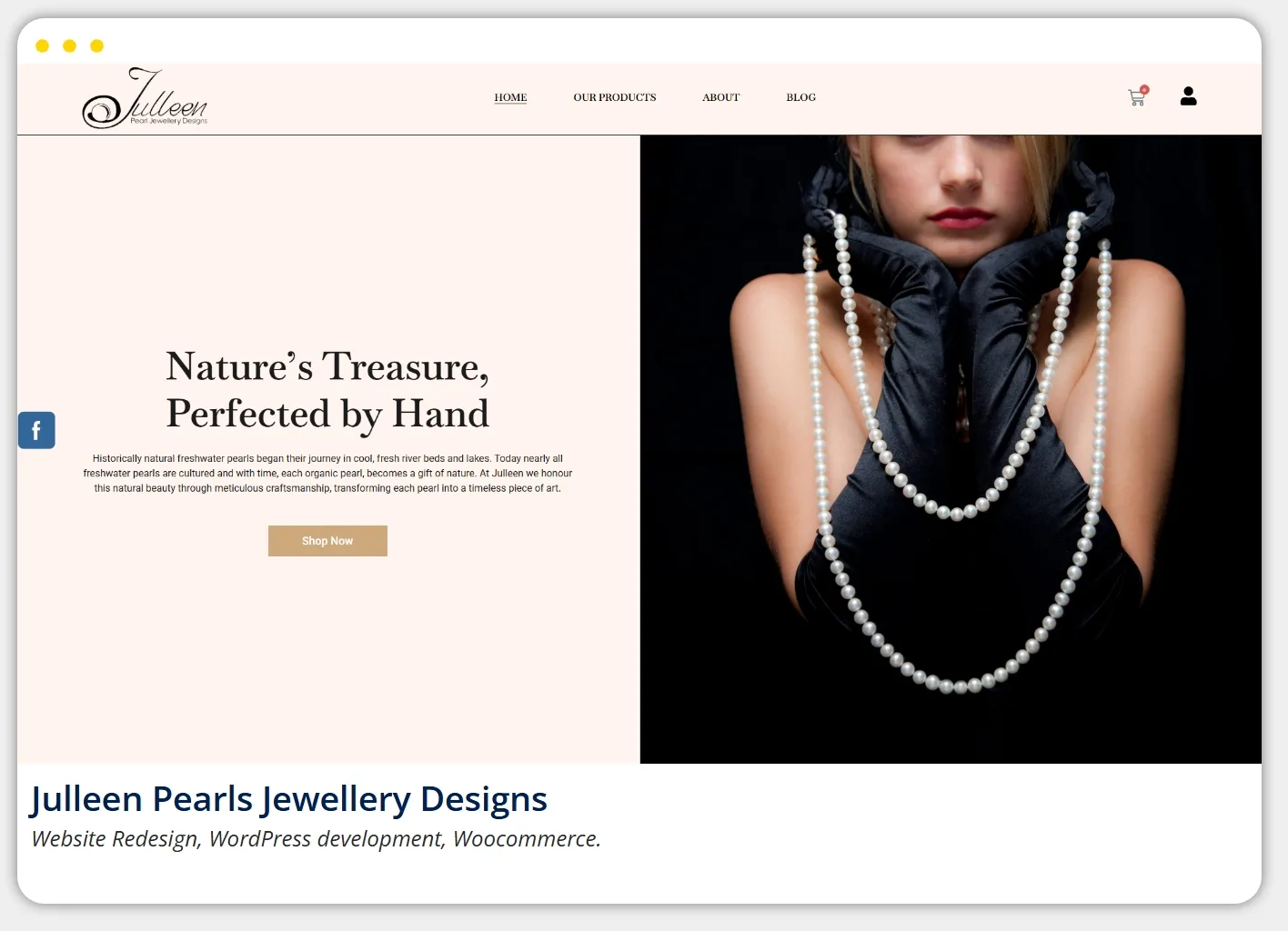
Julleen Pearls — fine jewellery
A full online store for handcrafted pearl and gemstone jewellery, drawing on a 25-year inventory vault, shipping across Australia and internationally.
- A complete e-commerce catalogue with browsing by jewellery type and by pearl or gemstone colour.
- Secured checkout through PayPal, Mastercard and Visa.
- Shipping rules including free Australian delivery over $100 and international over $140.
- Supporting content: blog, FAQs, customer feedback, and shipping, privacy and terms policies.
- Product photography presented so the pearls carry the page.
No traffic or revenue figures are quoted here, on this page or in the case study, because we do not have measured numbers we are entitled to publish. Every other agency's percentages deserve the same question.
What a store needs that a brochure site does not
This is why e-commerce is quoted per project rather than from the published web design bands: each item below is real build and testing work that a five-page trade site simply does not contain.
A checkout that survives a phone
Guest checkout, fields that respect autofill, and the postage cost visible before the final step. Most abandoned carts are decisions, not design.
Shipping rules that match reality
Flat rate, free over a threshold, weight bands, international zones, click and collect. Getting this wrong either loses sales or loses margin, quietly.
A catalogue people can browse
Categories and filters built around how your customers actually shop, not around how your supplier organises a spreadsheet.
Product photography that carries the page
On a store the photo is the product. It also has to be sized properly, or the catalogue becomes the slowest part of the site — see website speed.
Category pages that can rank
Category and product pages are where commercial search intent lands. They need real copy and a sane URL structure, which most store templates leave empty.
The boring compliance pages
Shipping, returns, privacy and terms. Customers read them before buying from somebody they have not heard of, and Australian Consumer Law expects them.
Which platform
Shopify
Take this if the store is the business. Payments, tax, shipping rules and security are somebody else's problem, and the monthly fee buys you not thinking about any of it. You are renting the platform, which is the trade.
WooCommerce on WordPress
Take this when the store is one part of a bigger content site, or you need product logic Shopify does awkwardly. You own it outright, and you carry the updates — which is what managed hosting is for.
If you sell fewer than a dozen items and mostly to people who already know you, a store may be the wrong spend entirely — an enquiry form and an invoice does the same job with no platform fee. We would rather say that on the first call. Our DIY versus hiring someone comparison makes the same argument at a smaller scale.
Tell us what you sell
Three fields. Roughly how many products, and whether you already have a store, is enough to start.
Or call 08 6323 2970
E-commerce questions
Shopify or WooCommerce?
How many products can you handle?
What does an online store cost?
Can you move my existing store to a new platform?
Will people actually buy on a phone?
Do I need ongoing help once it is live?
Looking for something more specific?
Four jobs that come up often enough to have a page of their own.
The rest of what we do
One team and one point of contact. See all services or pick one below.
Every price we charge is published — no "contact us for a quote". See the full pricing page.
Start with what you sell
Products, roughly how many, how you ship, and whether there is a store already. We will come back with a platform recommendation and a price.
Prefer to talk? Call 08 6323 2970